-
/
-
Travel info
/
-
Specific travel
/
-
Pet travel
/
Pets in Cabin
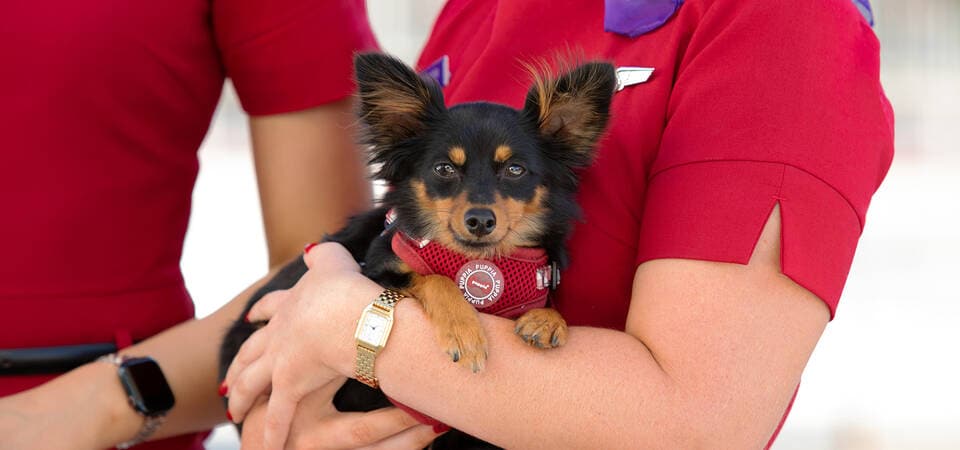
We’re excited to be Australia’s first airline to welcome small pets (dogs and cats only) into the cabin, putting a little extra wag in our tails and making flying even more wonderful.
We're excited to announce that Adelaide has joined our Pets in Cabin trial, with flights departing from Melbourne and the Gold Coast from 23 June 2026
Virgin Australia Pets in Cabin Adelaide, Sunshine Coast, Melbourne and Gold Coast routes are available to book for travel until 30 September 2026; services between Adelaide and Melbourne are available to book for travel until 31 January 2027^
Eligibility
To maintain the safety of the aircraft, our other customers and our staff, you cannot travel with a pet, and cannot purchase pets in cabin if you are:
- Travelling alone with an infant
- Under 18 years travelling alone, including unaccompanied minor(s)
- Travelling alone with an assistance animal
Guests with specific service requirements who wish to travel with a pet must first submit a Specific Service Request Form or Medical Clearance Guidelines Form for Virgin Australia’s review. Pet bookings can only proceed once this request has been assessed and approved.
For more information view the Pets in Cabin terms and conditions.
Before you book
To ensure a safe and comfortable journey for your furry friend, we need to check a few things before they can travel on board.
Pet requirements
Your pet must:
- Be a small cat or dog, with a combined weight (pet + carrier) of no more than 8kg
- Be at least 8 weeks old
- Be up to date with vaccinations
- Have a valid veterinary certificate (if required)
- Not be a prohibited breed
- Not have given birth within the last 7 days
- Fit comfortably in an approved pet carrier under the seat in front of you
- Remain in their closed carrier at all times except during security screening or whilst using the animal relief areas
- Must not enter the airport terminal outside of the carrier.
Carrier requirements
Your carrier must:
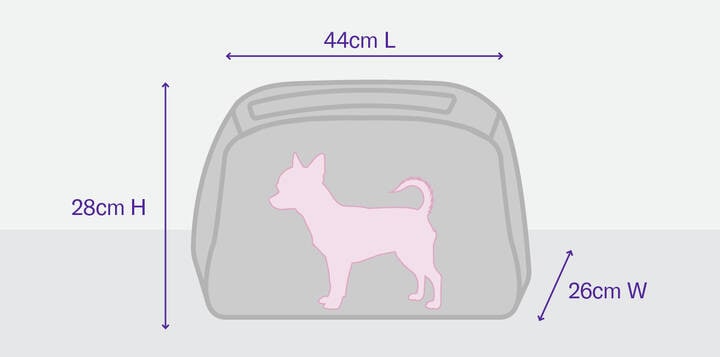
- Be an approved pet carrier (max dimensions 44cm L x 26cm W x 28cm H)
- Allow your pet to stand up, sit, turn around and lay down comfortably when the carrier is closed.
- Have all but one opening secured with cable ties prior to arriving at the airport.
- Be soft-sided, well-ventilated and escape proof
- Have a leak proof base and be lined with an absorbent mat (no puddles please!)
Ready for travel
Here are a few requirements to ensure you adequately prepare your pet for takeoff.
Note: Anko Pet Carrier Foldable
Currently the Anko Pet Carrier Foldable (both small and large) will not be approved for travel as it does not meet the maximum approved carrier dimensions and cannot be fully secured per requirements.
1. Find the right pet carrier
Your pet's carrier must:
- Be soft-sided, well-ventilated, escape-proof and leak-proof.
- Fit under the seat in front of you: Max dimensions L44cm x W26cm x H28cm
- Give your pet enough space to stand, sit, turn around and lay down comfortably when inside the closed carrier
- As a guide, a pet taller than the carrier may not be suitable and travel may be denied
- Have absorbent material inside for comfort and cleanliness.
- Have a combined pet + carrier weight of no more than 8kg
You must measure your carrier at its highest, widest and longest points as often the supplier measurements differ from the actual size.
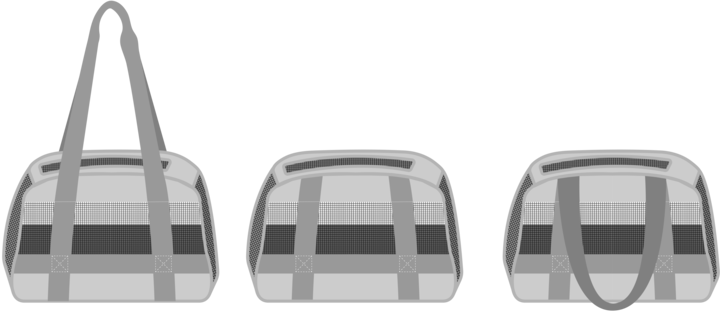
Measurements will be checked by Virgin Australia at the airport and pets will not be permitted to travel in non-compliant carriers.
What does the right carrier look like?
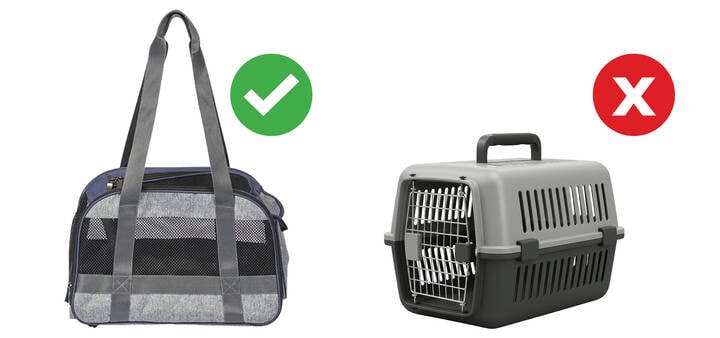
Not sure which carrier to choose? Here are a few options that meet our requirements and might work well for your pet.
Just a heads-up: We’re sharing these for your convenience only – we’re not endorsing any particular brand. Please check the details to make sure the carrier is the right fit for your furry friend.
2. Choose a strong, secure harness/collar and lead
- Use a strong and secure but comfortable harness/collar and lead
- Choose a lead with minimal or no metal to avoid screening delays.
- Bark collars are not permitted
- Your lead will be required to restrain your pet when it is outside its carrier (airport animal relief areas and security screening only)
- Your pet must arrive at the airport inside their closed carrier with the lead and harness/collar attached.
3. Check in with your vet
The risks of air travel can be higher for some animals because of changes in altitude, pressure in the cabin and changes in temperature. Before you fly, it’s a good idea to visit your vet to make sure your pet is healthy and ready to travel.
Veterinary certificate
Virgin Australia may require a veterinary certificate for your pet; this is an official health report from a registered vet confirming your four-legged friend is ready to fly. It must be issued within 14 days of your flight.
A veterinary certificate is required if your pet:
- Has a medical condition or is unwell
- Has had surgery in the last 2 weeks
- Has recently sustained an injury
- Is a brachycephalic (snub nosed) breed Requires you to complete a specific (Brachycephalic Fit-To-Fly assessment form)
- Is between 8 weeks & 12 weeks of age
- Is over 12 years old
- Is pregnant
- Needs to be sedated on the recommendation of your vet
You can also ask your vet about:
- Preparing your pet for travel
- If your pet is on chronic medication, ensuring you have enough for the duration of travel, including possible delays
- Options for veterinary care (if required) at your destination
Important information
Allergies or phobias? Check our Flying with Medical Conditions page for tips.
Assistance Animals such as guide dogs and working dogs = no pats, calling or talking to them (even if they’re adorable). Read more information on how to interact with guide dogs and their handler.
Relief area etiquette: Assistance animals get priority, give them space.
Priority paws: Assistance animals go through screening first.
We’re here to help. For further information call our Guest Contact Centre on 13 67 89.
FAQs
-
What if I have allergies or phobias?
The main sources of allergens from cats and dogs are from direct contact with animals, their saliva and their dander, which is material shed from dead flakes of skin, hair and fur. As the pet will travel in a carrier and must remain inside for the duration of the journey, direct contact is strictly limited to their travel companion (i.e. owner).
The aircraft ventilation system also greatly reduces risk of contact with dander as the airflow is from top to bottom and is refreshed using high efficiency particulate air (HEPA) 20-30 times per hour. With the pet carrier being placed underneath a seat, dander will be carried out of floor-level vents and filtered out, rather than recirculated. Therefore, for most guests, being seated a few rows away from pets will greatly reduce the likelihood of an allergen trigger occurring during the flight.
Guests with severe allergies should continue to identify themselves through our Medical process; Flying with Medical Conditions page.
-
What breeds are prohibited?
Please note that the following dog breeds (including crossbreeds) are prohibited from travel in compliance with the Australian “Customs Regulations 1956” and the “Environment Protection and Biodiversity Conservation Act 1999”:
Dog Breeds
- Czechoslovakian Wolfdog (Czechoslovakian Vlcak)
- Dogo Argentino
- Fila Brasileiro
- Japanese Tosa
- Kunming Wolfdog (Kunming Dog)
- Lupo Italiano (Italian Wolfdog)
- Perro de Presa Canario (Presa Canario)
- Pit Bulls (including all sub breeds)
- Saarloos Wolfdog (Saarloos Wolfhound)
Cat Breeds
- Savannah cat, domestic cat (Felis catus) crossed with serval cat (Felis serval)
- Safari cat, domestic cat crossed with Geoffroy cat (Oncifelis geoffroyi)
- Chausie, domestic cat crossed with Jungle cat (Felis chaus)
- Bengal cat, domestic cat crossed with Asian leopard cat (Prionailurus bengalensis).
-
What is a veterinary certificate?
Flying can be tough on pets. Changes in cabin pressure, temperature, and altitude may worsen existing health issues. That’s why, before their adventure, your vet should make sure your pet’s health is in good order.
That’s why Virgin Australia may require a veterinary certificate for your pet. This is an official health clearance from a registered vet confirming that your furry friend is ready to fly. It must be issued within 14 days of your flight.
It is a requirement if your pet:
- Has a medical condition or is unwell
- Has recently had surgery
- Has recently sustained an injury
- Is a brachycephalic (snub nosed) breed (Requires you to complete a specific Brachycephalic Fit-To-Fly assessment form)
- Is over 12 years old
- Is between 8 weeks and 12 weeks for age
- Is pregnant or has given birth less than 48 hours before travel
- If your vet recommends sedating your pet
-
What is a brachycephalic dog or cat? Why do they need a veterinary certificate?
These are pets with short, flat faces. While we love welcoming our brachycephalic breeds, there are specific welfare factors that need to be considered when travelling. Their squished-in snouts can make it harder for them to breathe and stay cool, especially when they’re stressed. Because every pet is different, a registered vet needs to check your pet and complete a special form to confirm they’re fit to fly safely (this includes cross breeds with the below animals). See list of brachycephalic dogs and cats below.
Dog breeds
- Affenpinscher
- American Bully
- American Bulldog
- Australian Bulldog
- Boston Terrier
- Boxer
- Brussels Griffon / Griffon Bruxellois
- British / English Bulldog
- Chow Chow
- Dogue De Bordeaux
- English Toy Spaniel / King Charles Spaniel
- French Mastiff
- French Bulldog
- Japanese Chin / Japanese Spaniel
- Lhasa Apso
- Neapolitan Mastiff
- Pekingese
- Pug (Chinese Pug, Dutch Pug, Japanese Pug)
- Shih-Zhu (Tsu) (Tzu)
- Tibetan Spaniel
- Valley Bulldog
Cat breeds
- Exotic Shorthair Cat
- Himalayan Cat
- Persian Cat
-
Can my pet fly if they’re pregnant?
Travel during pregnancy is not advised, particularly in the last third of pregnancy as there is a risk that your pet may give birth on the flight. Your pet will need medical clearance (veterinary certificate) if pregnant.
-
What is the minimum age my pet can fly?
Puppies and kittens must be at least 8 weeks of age before they can fly. Pressure and temperature conditions on the plane could lead to small animals feeling cold. Young animals need to be old enough to regulate their own body temperature to make the trip safe and comfortable for them.
-
What if my pet is anxious and needs to be sedated?
Sedation is not recommended, however, if your vet does recommend sedation, you must travel with a valid veterinary certificate. If your vet doesn’t recommend sedation, they’ll be able to advise you on other ways to manage stress.
For further information on why sedation is not recommended refer to the IATA site; IATA - Traveler's Pet Corner.
-
Why does my pet carrier need to be sealed?
A sealed carrier keeps your pet secure in busy, noisy airport zones and on the aircraft. Escaped pets can cause delays, stress, and even airport shutdowns; it also puts your pet at risk. Sealing the carrier also helps avoid issues with allergies, phobias, and means that assistance and working animals are not affected too.
Keeping your pet safely tucked in means a smoother journey for everyone.
-
What should I bring?
Keeping your little friend happy is essential to a smooth journey. Here are a few things that’ll help ensure this.
- Veterinary certificate (where required)
- Ensure your pet is up to date with their vaccinations
- Proof of any treatments required by States and Territories
- Medications (if required)
- Pet carrier (ensure it meets our standards)
- Harness/Collar (pet must be wearing one while travelling)
- Lead
- Muzzle (if your pet requires one)
- Small amount of food and treats for your cabin baggage (not to be placed in the carrier)
- Water bowl (collapsible) (not to be placed in the carrier)
- Extra absorbent mats
- Waste bags
- Antibacterial wipes (for surfaces and humans)
- Pet safe wipes (for your pet)
- Odour neutralisers (e.g. deodoriser drops)
- Small comfort soft toy (nothing squeaky) or clothing item, as long as there is no risk of the pet inappropriately chewing or swallowing it.
- Light sheet or blanket for covering for the carrier
- Collapsible/ disposable litter tray and litter (for cats, to be used in the designated animal relief areas only)
-
Is there anything I cannot bring?
You cannot bring bark collars of any kinds and leads/collars/harness should have minimal metal components (e.g. no stud collars or chains).
Avoid pet clothing or costumes during travel as they can delay security processes, prevent your pet from regulating their temperature or pose a risk to your pets safety (please link below links).
-
What is my carry-on baggage allowance?
The Pets in Cabin service includes your normal carry-on baggage allowance and is in addition your pet carrier (with Pet) which must weight no more than 8kgs. All the items you need in the airport or on the aircraft for your pet must be accommodated within these limits.
-
Will my pet be security screened?
Yes, it must be screened and cleared in accordance with the Australia Aviation Security Standards. Please note, your pet will need to be removed from its carrier to be screened.
Read more information about security screening at airports.
-
What if my pet cannot travel in the cabin?
If your pet is not approved/ineligible to travel in the cabin, your pet may be able to travel in the Cargo hold of the plane. Learn about pets travelling in cargo.
-
Will my pet get motion sick if there is turbulence?
Most pets handle flying like pros, even if the ride gets a little bumpy. If your furry friend is prone to motion sickness, chat with your vet before you travel. Turbulence might feel strange to them, but having you close by will comfort them.
-
What happens if my pet needs to use the bathroom during the flight?
There are no options for your pet other than the carrier. Carrying extra absorbent mats, antibacterial wipes (for surfaces), pet safe wipes (for your pet) and a plastic bag that soiled bedding can be sealed in will allow you to be able to deal with any accidents that may occur.
Please note that the carrier is not permitted to be opened at any point during the flight. Any accidents will need to be dealt with in an animal relief area at your arrival destination.
-
Can my pet travel if it needs medication?
In the first instance you should consult your vet for their advice. In some cases you may be able to select your flight time so it’s outside of normal medication times. If your pet is diabetic or has another illness requiring the injection of medication, you will only be able to administer this at the airport animal relief area (if located prior to check-in). Pack syringes and epi-pens in checked baggage only.
-
Can I take my pet into a Virgin Australia lounge?
No. To be compliant with food safety regulations, pets are not allowed in our lounges or in airport food and beverage outlets.
Related information
*Virgin Australia may vary its published Pets in Cabin fees at any time. The applicable Pets in Cabin fee will be the price published to you at the time you purchased the service.
Prices are per Pet in Cabin per sector (flight) and are additional to your own fare. Prices are in applicable booking currency, being in the country of origin specified in your booking purchase.
^subject to final airport approvals.