Best Airline Australia Pacific
Best Airline Staff Service Australia Pacific
Dangerous goods are items or substances that may endanger the safety of the aircraft or guests on board.
The following dangerous goods have restrictions for air travel:

Disabling devices such as mace, pepper spray or other devices containing an irritant or incapacitating substance are prohibited on a guest’s person or in their carry-on or checked baggage; as well as security type attaché cases containing dangerous goods such as lithium batteries or pyrotechnic devices are all strictly forbidden.
The following items must not be taken on board (in carry-on or checked baggage) a Virgin Australia domestic aircraft under any circumstance:
Note: If you illegally take dangerous goods on board, even inadvertently, you may be liable to prosecution and severe penalties apply.
Some dangerous goods are permitted to be carried by passengers. The following dangerous goods must be declared at check in to be approved for travel, or unpacked before you take off. If you do not declare the carriage of dangerous goods at time of check in, even inadvertently, you may be liable to prosecution and severe penalties apply.
Permitted in checked baggage only - guests are permitted to take quantities not exceeding 5kg of ammunition; which are classified as inert projectile cartridges, small arms cartridges, small arms blank cartridges or blank weapon cartridges (Division 1.4s UN0012 or UN0014). Limitations are per guest and allowances for more than one guest must not be combined into one or more packages.
Permitted in checked baggage only – stoves and containers must be completely drained of all liquid fuel and action has been taken to nullify the danger.
To nullify the danger, the empty fuel container must be allowed to drain for at least 1 hour and the container left uncapped for a minimum of 6 hours to allow any residual fuel to evaporate; or cooking oil can be added to the container to elevate the flash point and then empty the fuel tank. There must be no strong smell of fuel remaining on the container. The cap must then be securely fastened and be wrapped in an absorbent material such as paper towel and placed in a polyethylene or equivalent bag. The top of the bag must then be sealed or gathered and closed with an elastic band or twine.
Note: This exception is NOT applicable to items with internal combustion engines such as chain saws, brushcutters and/or lawnmowers. These items are not permitted for carriage either new or used.
Permitted as checked baggage only – the battery terminals must be insulated to prevent accidental short circuiting such as taping terminals with electrical tape or being fully enclosed within a battery container, the wheelchair must be prevented from damage and unintentional activation such as an on/off switch is in the 'off' position, and the battery must be securely attached to the wheelchair or mobility aid.
Permitted as checked baggage only – the collapsed wheelchair or mobility aid is to have the battery removed and the wheelchair/device carried as checked baggage.
For wheelchair/devices with lithium batteries – the removed battery must be carried in a strong, rigid packaging, the battery terminals prevent from accidental short circuiting such as taping terminals with electrical tape, and the battery must be carried as carry on baggage.
For wheelchair/devices with non-spillable batteries – the removed battery must be carried in a strong, rigid packaging, the battery terminals prevent from accidental short circuiting such as taping terminals with electrical tape, and the battery must be carried as checked baggage.
Note: This exception is ONLY applicable when the wheelchair or other battery powered mobility device is a collapsible model, designed to have the battery removed and the item is to travel in a collapsed state. This is not applicable should the item travel in an upright/un-collapsed state.
Permitted as carry-on or checked baggage – Items such as laptops, watches, video recorders and mobile phones. Lithium batteries must not exceed 160Wh and non-spillable batteries must not exceed 12 volts. Items must be protected in a casing to ensure the battery does not become dislodged during transport or inadvertently activated such as in a hard moulded case for items similar to power tools, completely enclosed within a laptop/ mobile phone, or have the battery secured to the device for items similar to children’s toys.
Note: Items containing batteries under 100Wh or under 12 volts do not need to be declared at check in.
Note: Conversion from Ah (Amp hours) to Wh is: Ah x Voltage = Wh.
Permitted as carry-on only – any battery that is not contained within a device must have the terminals insulated to prevent accidental short circuiting such as taping terminals with electrical tape or in its original packaging. For any spare lithium battery that exceeds 100Wh, or any spare non-spillable battery, a maximum of 2 batteries are permitted per guest. Lithium batteries that exceed 160Wh and non-spillable batteries that exceed 12 volts are not permitted for carriage.
Note: Items containing batteries under 100Wh do not need to be declared at check in.
Note: Conversion from Ah (Amp hours) to Wh is: Ah x Voltage = Wh.
Permitted as carry-on or checked baggage – Items such as cameras, mobile phones, laptops and camcorders.
Note: A maximum of 2 spare fuel cells are permitted per guest and must travel as carry on baggage only.
Permitted as carry-on or checked baggage – guests are permitted only 1 per person and the backpack must be packed in a manner that it cannot be accidently activated. The airbags within the backpacks must be fitted with pressure relief valves.
Permitted as carry-on or checked baggage – battery-powered equipment capable of generating extreme heat, which would cause a fire if activated, such as diving torches and soldering irons are permitted providing the item is disabled so there is no chance that they can be inadvertently switched on, either by removing the battery or globe.
Note: Any battery that has been removed must be protected against short circuiting such as having the terminals covered with electrical tape and the battery must travel as carry-on luggage only.
Permitted as carry-on or checked baggage – guests are permitted to take up to 2.5kg of dry ice if used to pack perishables, and in a ventilated container. Guests are not permitted to combine more than the amount permitted for one person.
Permitted as carry-on or checked baggage - Sometimes termed as 'Dry Shippers' and permitted only if the liquid nitrogen is fully absorbed and the package has the capacity to release any build-up of pressure. Only non-dangerous goods can be transported within the 'Dry Shipper'.
Permitted as carry-on or checked baggage – Guests are permitted with a limit of 4 small cylinders (not more than up to 50mL water capacity) containing carbon dioxide or other non-flammable gas, are permitted.
Permitted as carry-on or checked baggage - Guests are permitted to take medicinal oxygen cylinders on board providing:
Note: Liquid oxygen systems are forbidden for transport.
Permitted as carry-on or checked baggage – Guests are permitted to travel with items such as external defibrillator, nebulisers or oxygen concentrators providing that the battery is contained within the device to prevent inadvertently activation during transport.
Permitted as checked baggage only – Guest permitted to travel with metal firesticks only provided that if the wicks have been used, they are thoroughly cleaned, there is no strong residual smell of fuel, the heads are covered with a plastic, polythene or alike bag, and the bag is sealed or gathered and closed with an elastic band or twine.
Some dangerous goods are permitted to be carried by passengers. The following dangerous goods do not need to be declared at check in prior to carriage, providing the dangerous good is within the limitations prescribed below. If you illegally take dangerous goods on board, even inadvertently, you may be liable to prosecution and severe penalties apply.
Permitted as checked baggage only – Aerosols are permitted that are under a net quantity of 2kg/ 2L (including any toiletry and medicinal articles mentioned below) and a single aerosol does not exceed 0.5kg/ 0.5L. The release valve on the aerosol must be protected by a cap or other suitable means to prevent inadvertent release of the contents. The aerosol must not have any other subsidiary risk and must be for sporting or home use only.
Permitted as carry-on or checked baggage – Articles such as hair sprays, deodorants and perfumes are permitted that are under a net quantity of 2kg/ 2L (including any aerosols mentioned above) and a single article does not exceed 0.5kg/ 0.5L. A release valve on the aerosol must be protected by a cap or other suitable means to prevent inadvertent release of the contents. The aerosol must not have any other subsidiary risk and be for personnel use only.
Permitted as carry-on or checked baggage – A maximum net total of 5L per person is permitted providing the alcohol is contained within retail packaging. The alcohol must not be more than 70% alcohol by volume and consumption alcohol carried on board is not permitted on the aircraft.
Permitted as carry-on or checked baggage – Either worn for the operation of a mechanical limb and any spare cylinders of similar size if required to ensure an adequate supply for the duration of the journey permitted.
Permitted as carry-on or checked baggage – Packed with small quantities (no more than 30 mL) of flammable liquid in leak proof containers or heat sealed plastic bags. The total quantity (if a number of plastic bags/bottles are carried) of flammable liquid must be no more than 1L.
Note: Flammable liquid may only be ethanol/ethyl alcohol/solution, formaldehyde solution, alcohol or isopropanol.
Permitted as carry-on or checked baggage – Only one device is permitted per guest provided the safety cover is securely fitted over the heating element.
Note: Gas refills for such devices are not permitted in carry-on or checked in baggage.
Permitted as carry-on or checked baggage – 1 permitted per guest for personal use and the thermometer is housed in a protective case.
Permitted on ones-self only - Either one small compressed gas lighter or a box of safety matches or a liquid fuel lighter that has the flammable liquid fully absorbed, is permitted only when carried by the guest on their body.
Note: Blue flame cigarette, pipe lighters and ‘Strike anywhere’ matches are forbidden for air transport.
Any material which has narcotic, noxious, irritating or other properties that in the case of spillage, leakage or pressurisation on the aircraft could cause extreme annoyance or discomfort to others are not permitted on-board or have additional restrictions for carriage. Such items are:
Please contact the Virgin Australia Guest Contact Centre on 13 6789 or e-mail: reservations@virginaustralia.com.
Dangerous goods are items or substances that may endanger the safety of the aircraft or guests on board.
The following dangerous goods have restrictions for air travel:
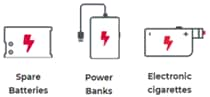
Disabling devices such as mace, pepper spray or other devices containing an irritant or incapacitating substance are prohibited on a guest’s person or in their carry-on or checked baggage; as well as security type attaché cases containing dangerous goods such as lithium batteries or pyrotechnic devices are all strictly forbidden.
The following items must not be taken on board (in carry-on or checked baggage) a Virgin Australia international aircraft under any circumstance:
Note: If you illegally take dangerous goods on board, even inadvertently, you may be liable to prosecution and severe penalties apply.
Some dangerous goods are permitted to be carried by passengers. The following dangerous goods must be declared at check in to be approved for travel, or unpacked before you take off. If you do not declare the carriage of dangerous goods at time of check in, even inadvertently, you may be liable to prosecution and severe penalties apply.
Permitted in checked baggage only - guests are permitted to take quantities not exceeding 5kg of ammunition; which are classified as inert projectile cartridges, small arms cartridges, small arms blank cartridges or blank weapon cartridges (Division 1.4s UN0012 or UN0014). Limitations are per guest and allowances for more than one guest must not be combined into one or more packages.
Note: Many Countries have specific regulations regarding the carriage of ammunition. Please ensure you are aware of any additional local requirements for your place of departure and arrival.
Permitted in checked baggage only – stoves and containers must be completely drained of all liquid fuel and action has been taken to nullify the danger.
To nullify the danger, the empty fuel container must be allowed to drain for at least 1 hour and the container left uncapped for a minimum of 6 hours to allow any residual fuel to evaporate; or cooking oil can be added to the container to elevate the flash point and then empty the fuel tank. There must be no strong smell of fuel remaining on the container. The cap must then be securely fastened and be wrapped in an absorbent material such as paper towel and placed in a polyethylene or equivalent bag. The top of the bag must then be sealed or gathered and closed with an elastic band or twine.
Note: This exception is NOT applicable to items with internal combustion engines such as chain saws, brushcutters and/or lawnmowers. These items are not permitted for carriage either new or used.
Permitted as checked baggage only – the battery terminals must be insulated to prevent accidental short circuiting such as taping terminals with electrical tape or being fully enclosed within a battery container, the wheelchair must be prevented from damage and unintentional activation such as on/off switch is in the 'off' position, and the battery must be securely attached to the wheelchair or mobility aid.
Permitted as checked baggage only – the collapsed wheelchair or mobility aid is to have the battery removed and the wheelchair/device carried as checked baggage.
For wheelchair/devices with lithium batteries – the removed battery must be carried in a strong, rigid packaging, the battery terminals prevent from accidental short circuiting such as taping terminals with electrical tape, and the battery must be carried as carry on baggage.
For wheelchair/devices with non-spillable batteries – the removed battery must be carried in a strong, rigid packaging, the battery terminals prevent from accidental short circuiting such as taping terminals with electrical tape, and the battery must be carried as checked baggage.
Note: This exception is ONLY applicable when the wheelchair or other battery powered mobility device is a collapsible model, designed to have the battery removed and the item is to travel in a collapsed state. This is not applicable should the item travel in an upright/un-collapsed state.
Permitted as carry-on or checked baggage – Items such as laptops, watches, video recorders and mobile phones. Lithium batteries must not exceed 160Wh and non-spillable batteries must not exceed 12 volts. Items must be protected in a casing to ensure the battery does not become dislodged during transport or inadvertently activated such as in a hard moulded case for items similar to power tools, completely enclosed within a laptop/ mobile phone, or have the battery secured to the device for items similar to children’s toys.
Note: Items containing batteries under 100Wh or under 12 volts do not need to be declared at check in.
Note: Conversion from Ah (Amp hours) to Wh is: Ah x Voltage = Wh.
Permitted as carry-on only – Any battery that is not contained within a device must have the terminals insulated to prevent accidental short circuiting such as taping terminals with electrical tape or in its original packaging. For any spare lithium battery that exceeds 100Wh, or any spare non-spillable battery, a maximum of 2 batteries are permitted per guest. Lithium batteries that exceed 160Wh and non-spillable batteries that exceed 12 volts are not permitted for carriage.
Note: Items containing batteries under 100Wh do not need to be declared at check in.
Note: Conversion from Ah (Amp hours) to Wh is: Ah x Voltage = Wh.
Permitted as carry-on or checked baggage – Items such as cameras, mobile phones, laptops and camcorders.
Note: A maximum of 2 spare fuel cells are permitted per guest and must travel as carry on baggage only.
Permitted as carry-on or checked baggage – guests are permitted only 1 per person and the backpack must be packed in a manner that it cannot be accidently activated. The airbags within the backpacks must be fitted with pressure relief valves.
Permitted as carry-on or checked baggage – battery-powered equipment capable of generating extreme heat, which would cause a fire if activated, such as diving torches and soldering irons are permitted providing the item is disabled so there is no chance that they can be inadvertently switched on, either by removing the battery or globe.
Note: Any battery that has been removed must be protected against short circuiting such as having the terminals covered with electrical tape and the battery must travel as carry-on luggage only.
Permitted as carry-on or checked baggage – guests are permitted to take up to 2.5kg of dry ice if used to pack perishables, and in a ventilated container. Guests are not permitted to combine more than the amount permitted for one person.
Permitted as carry-on or checked baggage - Sometimes termed as 'Dry Shippers' and permitted only if the liquid nitrogen is fully absorbed and the package has the capacity to release any build-up of pressure. Only non-dangerous goods can be transported within the 'Dry Shipper'.
Permitted as carry-on or checked baggage – Guests are permitted with a limit of 4 small cylinders (not more than up to 50mL water capacity) containing carbon dioxide or other non-flammable gas, are permitted.
Permitted as carry-on or checked baggage - Guests are permitted to take medicinal oxygen cylinders on board providing:
Note: Liquid oxygen systems are forbidden for transport.
Permitted as carry-on or checked baggage – Guests are permitted to travel with items such as external defibrillator, nebulisers or oxygen concentrators providing that the battery is contained within the device to prevent inadvertently activation during transport.
Permitted as checked baggage only – Guest permitted to travel with metal firesticks only provided that if the wicks have been used, they are thoroughly cleaned, there is no strong residual smell of fuel, the heads are covered with a plastic, polythene or alike bag, and the bag is sealed or gathered and closed with an elastic band or twine.
Some dangerous goods are permitted to be carried by passengers. The following dangerous goods do not need to be declared at check in prior to carriage, providing the dangerous good is within the limitations prescribed below. If you illegally take dangerous goods on board, even inadvertently, you may be liable to prosecution and severe penalties apply.
Permitted as checked baggage only – Aerosols are permitted that are under a net quantity of 2kg/ 2L (including any toiletry and medicinal articles mentioned below) and a single aerosol does not exceed 0.5kg/ 0.5L. The release valve on the aerosol must be protected by a cap or other suitable means to prevent inadvertent release of the contents. The aerosol must not have any other subsidiary risk and must be for sporting or home use only.
Permitted as carry-on or checked baggage – Articles such as hair sprays, deodorants and perfumes are permitted that are under a net quantity of 2kg/ 2L (including any aerosols mentioned above) and a single article does not exceed 0.5kg/ 0.5L. A release valve on the aerosol must be protected by a cap or other suitable means to prevent inadvertent release of the contents. The aerosol must not have any other subsidiary risk and be for personnel use only.
Permitted as carry-on or checked baggage – A maximum net total of 5L per person is permitted providing the alcohol is contained within retail packaging. The alcohol must not be more than 70% alcohol by volume and consumption alcohol carried on board is not permitted on the aircraft.
Note: Liquid, Aerosol and Gel (LAGs) restrictions may apply for alcohols carried on board. Please refer to the Department of Infrastructure for further information on LAGs restrictions.
Permitted as carry-on or checked baggage – Either worn for the operation of the mechanical limb and any spare cylinders of similar size if required to ensure an adequate supply for the duration of the journey permitted.
Permitted as carry-on or checked baggage – Packed with small quantities (no more than 30 mL) of flammable liquid in leak proof containers or heat sealed plastic bags. The total quantity (if a number of plastic bags/bottles are carried) of flammable liquid must be no more than 1L.
Note: Flammable liquid may only be ethanol/ethyl alcohol/solution, formaldehyde solution, alcohol or isopropanol.
Permitted as carry-on or checked baggage – Only one device is permitted per guest provided the safety cover is securely fitted over the heating element.
Note: Gas refills for such devices are not permitted in carry-on or checked in baggage.
Permitted as carry-on or checked baggage – 1 permitted per guest for personal use and the thermometer is housed in a protective case.
Permitted on ones-self only - Either one small compressed gas lighter or a box of safety matches or a liquid fuel lighter that has the flammable liquid fully absorbed, is permitted only when carried by the guest on their body.
Note: Blue flame cigarette, pipe lighters and ‘Strike anywhere’ matches are forbidden for air transport.
Any material which has narcotic, noxious, irritating or other properties that in the case of spillage, leakage or pressurisation on the aircraft could cause extreme annoyance or discomfort to others are not permitted on-board or have additional restrictions for carriage. Such items are:
Civil Aviation Regulatory Authorities for each country may enforce further restrictions on the carriage of dangerous goods transport to, through or out of that country.
A number of additional restrictions are enforced for passengers travelling to/from the USA such as:
For further information and the latest restrictions in place please refer to the TSA website.
Please contact the Virgin Australia Guest Contact Centre on 13 67 89 or e-mail: reservations@virginaustralia.com.
© Virgin Australia Airlines Pty Ltd ABN 36 090 670 965